
Fearless Humility

Our culture is not one that happily embraces humility. You may have noticed. Some see humility as putting ourselves down. They assert that if we are humble, it’s because we don’t believe in ourselves. They repeatedly attach humility to shame and/or weakness. This sentiment is expressed in a song from one of my favorite musicals, “Camelot”. Mordred declares:
“I find humility means to be hurt.
It's not the earth the meek inherit, it's the dirt.”
There is a common expression, to eat humble pie. In Webster’s online dictionary we find humble pie defined as “a figurative serving of humiliation.” Humble pie equals humiliation.
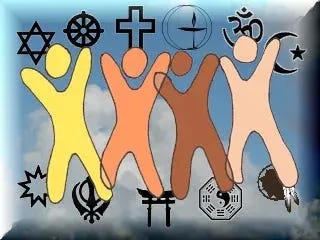
And the subject of this post is “Fearless Humility”? Yes! Fearless, empowered humility – which means I don’t share our culture’s disdain of humility. I embrace it. More than that, and speaking as an Interfaither, our diverse spiritual traditions embrace humility as well.
Not to say that humility will come naturally in a culture that so widely disparages it. Despite calls to the contrary from our spiritual traditions, we are bombarded daily by claims that attach humility to shame. In our so very divided world, we are told not to be humble but to be proud of ourselves – this despite what our spiritual traditions have repeatedly tried to teach us.
From Proverbs – “Pride goeth before destruction, and a haughty spirit before a fall.”
From the Dhammapada of Buddhism – “Give up anger; renounce pride; transcend the fetters of worldly attachments.”
From the Qur’an of Islam – “Let your gait be modest and your voice low. The most hideous of voices is the braying of an ass.”
From the Analects of Confucianism – “The humane are high-minded, not proud; the vulgar are proud, not high-minded.”
From Taoism – “Those who boast of their accomplishments diminish what they have done.”
From Hinduism – “Shun all pride and jealousy.”
And my favorite, from the Prophet Micah – “What does the Lord ask of you? Only this. Act with justice, love compassion, and walk humbly with your God.”
Our spiritual traditions would not have to keep reminding us to be humble, century after century, if it weren’t for the unfortunate fact that we seem desperately to cling to pride – century after century.
Ok, what’s so important about humility? And why do we keep forgetting? I believe these to be truly important questions; not to be taken lightly.
I deeply believe that humility involves strength, not weakness. I believe humility empowers, not weakens us. So how did we get where we are?
Again, all I’m really doing here is embracing what our diverse spiritual traditions have tried so hard to teach us.
Humility is not saying I am nothing. What humility is saying is that while I’m a valuable human being, I’m no more valuable than all my brothers and sisters. This is crucial. Embracing humility teaches us that our value as a human being is not made greater by our wealth, nor is it lessened by a lack of wealth. Our value as a human being is not made greater by our fame, nor is it lessened by a lack of fame. It is not made greater by our race, ethnicity, or spiritual tradition; nor is it lessened by our race, ethnicity, or spiritual tradition. Humility is the great equalizer.
In his prose poem “Desiderata,” Max Ehrmann writes, “You are a child of the universe, no less than the trees and the stars; you have a right to be here.” Humility teaches us that we are all children of the universe, no less than the trees and the stars; and we all have a right to be here.
Humility embraced and lived is empowering.
And pride? In our divided world, we are repeatedly told to be proud of ourselves. But I would strongly submit that pride, and particularly a boisterous pride, finds its genesis in a feeling of insecurity and lack of self-worth. Pride is, then, a sign of weakness, not strength. It is the people who must continually broadcast how important they are, how wealthy they are, how much “better” they are than others who, deep at their core, believe their lives to be unimportant and without meaning.
Those who seek power, appeal to and indeed encourage pride. One of the surest ways to manipulate a people is to appeal to their pride. “I will keep you superior.”
It is the humble who, secure in their own self-worth, are able to respect others and not feel that their fragile sense of self requires them to put others down. Thus, people seeking power belittle the humble. Why? Because they fear them.
Again, and most emphatically, healthy humility does not equate with feeling inadequate or worthless. Timidity is not humility. Lack of self-worth is not humility. Feeling shame is not humility. Indeed, I believe there is no way to approach life humbly unless we feel secure that the person we are has meaning, that we truly are no less than the trees and the stars and have a right, an irrevocable right to be here.
Today’s post is titled “Fearless Humility”. Really? What fear is vanquished by humility?
A humble people do not see themselves as somehow “better” than others. Therefore, the fear of losing stature is vanquished. A humble people do not define themselves as knowing everything. Therefore, the fear losing stature by admitting that we don’t have all the answers vanishes.
Humility does not restrict us. Rather it helps us to embrace that we all have value. Humility, then frees us to act in the world without the shackles of worry about how others may or may not see us.
Humility, frees us from a fear of failure. I believe that the only requirement an engaged person of humility has is to do their best – with no value judgement as to where their best lands in the grand scheme of things. I believe that the only potential failure that a humble people need be concerned with is did we fail to do the best we could, without comparison to anyone else!
For me, this is why the Prophet Micah calls on us to act with justice, love compassion and walk humbly. Justice, compassion, and humility. The three are connected. Humility frees us to act with justice and compassion. And may we never forget that we ALL have a right to be here.
So much to do and nothing to prove! Now that is truly empowering.
So well put, Steven! And Micah is my favorite, too. It is truly liberating to be able to say, "Gee, I did that wrong" or "you were right!" and so many other ways. Thank you.